By-name data gives communities a real-time, person-specific understanding of who is experiencing homelessness and what it will take to house them. In a moment when national data has gone dark, communities with by-name data can still see clearly and act decisively.
Knowing people by name
In too many cities, homelessness has only been measured through annual surveys called the point-in-time count: volunteers go out on a single night and try to tally how many people they find. Those snapshots are useful for national estimates. They are not detailed enough to help a community respond to what’s happening right now.
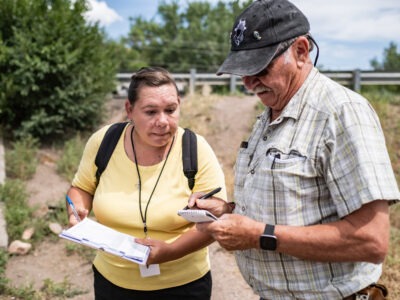
Communities in our Built for Zero network take a different approach. They maintain real-time, person-specific data: a comprehensive and up-to-date record of every individual experiencing homelessness in their system. Local teams know people by name. They know what each person looks like, what they need, how long they’ve been homeless, and what’s standing between them and housing.
This data isn’t collected for a report. It’s used every day to make decisions, assign outreach workers, prioritize housing placements, and hold local leaders accountable for results.
What is by-name data?
By-name data (sometimes referred to as a by-name list) is a comprehensive data source of every person in a community experiencing homelessness, updated in real time. Using information collected and shared with their consent, each person on the list has a record that includes their name, history of homelessness, health, and housing needs. This data is updated monthly, at a minimum.
What communities track each month
Every month, communities using by-name data track a set of key indicators that reveal how the system is performing in real time.

How many people are currently experiencing homelessness. This is the active count: the total number of individuals known to the system right now. Because it’s updated continuously, it reflects the current reality rather than a one-night estimate from months ago.

How many people entered homelessness (inflow). New entries into the system show whether homelessness is increasing, holding steady, or declining. A spike in inflow can signal a crisis like rising evictions, a loss of affordable housing, or a gap in prevention services.

How many people entered housing (outflow). This is the clearest measure of system performance: how many people moved into housing this month. When outflow exceeds inflow, the community is reducing homelessness over time.

How many people are living unsheltered. This tells communities how many people are on the streets, in encampments, or in other places not meant for habitation. Reducing this number is often the most visible sign of progress and the one most closely tied to public confidence.
Together, these indicators create a dynamic picture. A community can see at any point whether it’s making progress, where the bottlenecks are, and what needs to change.
How the data drives action
By-name data changes how a community responds to homelessness. Instead of working from estimates and waiting for annual reports, local teams use the data to act in real time.
Outreach workers are assigned to specific individuals. Because the system knows who is experiencing homelessness and where, outreach teams can be directed to the people who need help rather than covering a geography and hoping to find them.
Housing placements are time-bound. Communities set targets for how quickly someone should move from homelessness to housing. The data shows whether those targets are being met and where delays are occurring.
Returns to homelessness are tracked. When someone who was previously housed re-enters the system, it shows up in the data. Communities use this information to improve housing matches, strengthen support services, and prevent the same people from cycling in and out.
Leaders coordinate across systems. By-name data gives leaders across housing, health care, outreach, and public safety a shared picture of what’s happening. Case conferencing, where teams review individual cases together, is built around this data. Decisions are made collectively, with shared accountability for outcomes.
The system can respond to early warning signs. When communities monitor their data closely, they can detect early signals of trouble: rising inflow, a slowdown in housing placements, or increased unsheltered counts in a specific neighborhood. This allows them to shift resources, expand prevention, and act before the problem gets worse.

Building quality data over time
By-name data is only as useful as it is accurate. Communities in Built for Zero work toward a standard of data quality that ensures the information they’re using reflects reality.
Quality by-name data is comprehensive, meaning it covers the entire geography of the community and the entire population experiencing homelessness, not just those in shelters or those connected to a single program. It is person-specific, meaning each record represents a real individual, with enough detail to distinguish between people and to track their journey through the homeless response system. And it is current, meaning it is updated at least monthly, and ideally in real time.
Not every community starts with quality data. Many begin with incomplete systems, fragmented records, and inconsistent updating. That’s expected. Building quality data is a process, and Built for Zero supports communities in refining that process. What matters is that communities commit to improving their data over time and use the data they have to make better decisions now.
Common questions about by-name data
How is a by-name list different than the point-in-time count?
The U.S. Department of Housing and Urban Development (HUD) mandates an annual census of people experiencing homelessness, called the point-in-time count.
Historically, communities have relied heavily on the point-in-time count to understand whether homelessness is improving. They’ve used this number to develop local strategies and make budget decisions. But the count is an estimate from a single moment. There are no names behind it and no way to know what that number is today.
The point-in-time count is like a photograph taken with an early camera: if the subject moves, the picture is distorted. Homelessness changes every night. And the picture takes months to develop.
By-name data provides something different: a continuous, person-specific record that is updated regularly. It gives communities actionable information they can use right now, not a hazy picture of the past.
What is the difference between a by-name list and HMIS data?
A Homeless Management Information System (HMIS) is a database that communities use to track how people experiencing homelessness interact with services. Communities incorporate HMIS data into their by-name data.
By continually consolidating data from HMIS and local partners outside of the HUD-funded homeless response system, plus constant outreach to individuals who could be disconnected from supportive services, communities can identify everyone experiencing homelessness and support them from first contact through permanent, stable housing. This continual, by-name approach gives all stakeholders a clear understanding of the community’s homelessness challenge in real time, allowing quicker case resolution for individuals and more efficient resource allocation across the community.
What about privacy?
In most communities, anyone on the by-name list signs a consent form that stipulates with whom their data can be shared. Community teams decide who this data will be shared with, and in most communities, this data is only used to help people connect with safe and stable long-term housing.
How do communities know they have achieved quality by-name data?
Built for Zero communities work with Community Solutions coaches to help develop quality data on their local homeless population. Community Solutions provides a scorecard that uses qualitative and quantitative data to ensure that communities have covered their full jurisdiction and that all homeless service providers are coordinating their efforts.
The scorecard assesses community participation and coverage, ensuring that a community is capturing all adults experiencing homelessness, including people living without shelter, people in shelters, people in transitional housing, people without homes about to enter hospitals or jails, and people fleeing domestic violence. It also assesses policies and procedures, ensuring that communities have systems in place to accurately reflect people entering or exiting homelessness and to maintain timely and accurate data. Finally, it assesses data infrastructure, ensuring the capacity to track system-wide inflow and outflow, and to monitor critical population-based statuses in real time, including age, household size, chronic homeless status, and veteran status.
Some communities start by creating by-name data focused on a specific population, like single adults. Others build data systems that account for all households experiencing homelessness. The goal is that eventually, communities will build one comprehensive data set that accounts for all people experiencing homelessness within a given community.
What about data reliability?
Built for Zero uses a concept called balanced data to measure how reliable a community’s data is. Data are balanced if the change in the active count from one month to the next equals the difference between inflow and outflow. In other words, it balances month over month, just like a checkbook.
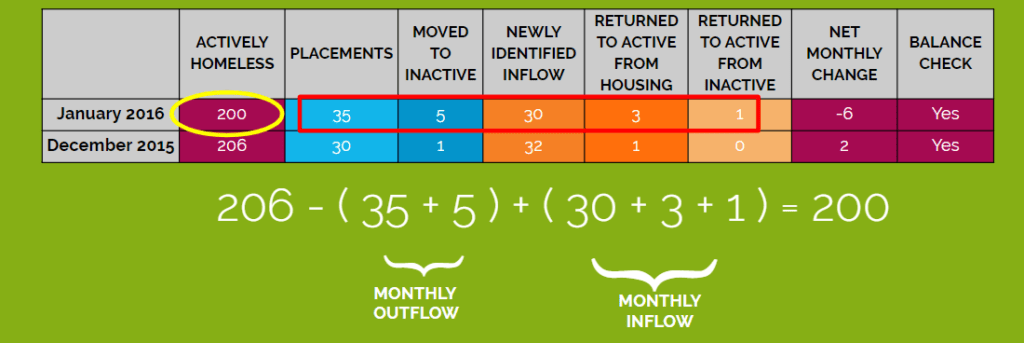
How do we calculate the data reliability percentage?
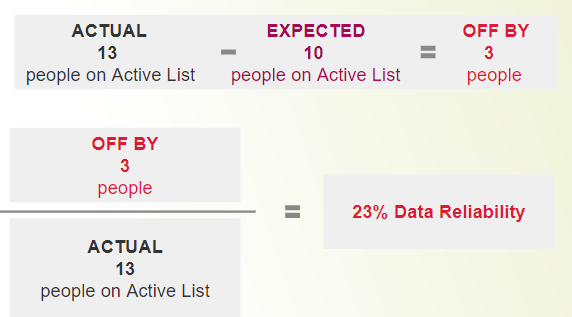
Data Reliability measures how far off the data is from being balanced. To arrive at a Data Reliability Percentage, we determine how far off the ACTUAL number of people on our Active List is from the EXPECTED number of people on our Active List and look at the difference as a percentage of the number of people on our Active List.
What by-name data makes possible
When communities know every person experiencing homelessness by name, they can measure what matters: whether homelessness is becoming rare, brief, nonrecurring, safe, and believable.
By-name data is the foundation of Built for Zero’s measurement framework. It’s what makes it possible to verify reductions, track trends in real time, and show residents and leaders that progress is real.