Introduction
Over the past decade, Community Solutions’ Built for Zero initiative has shown that making homelessness rare and brief is achievable. In communities across the country, success has reflected the same powerful pattern:
- Communities achieve sustainable, population-level reductions when their homeless response system is grounded in four foundational capabilities, and
- That progress accelerates when the broader environment provides three enabling conditions and three necessary resources.
This Theory of Change reflects what we’ve learned working with communities nationwide, supported by findings from an independent evaluator, ORS Impact. It gives communities a shared reference point to identify gaps, target strategies, and strengthen their systems. As the Built for Zero method scales, including through open-source adoption, this framework can guide new communities building outcomes-focused homeless response systems.
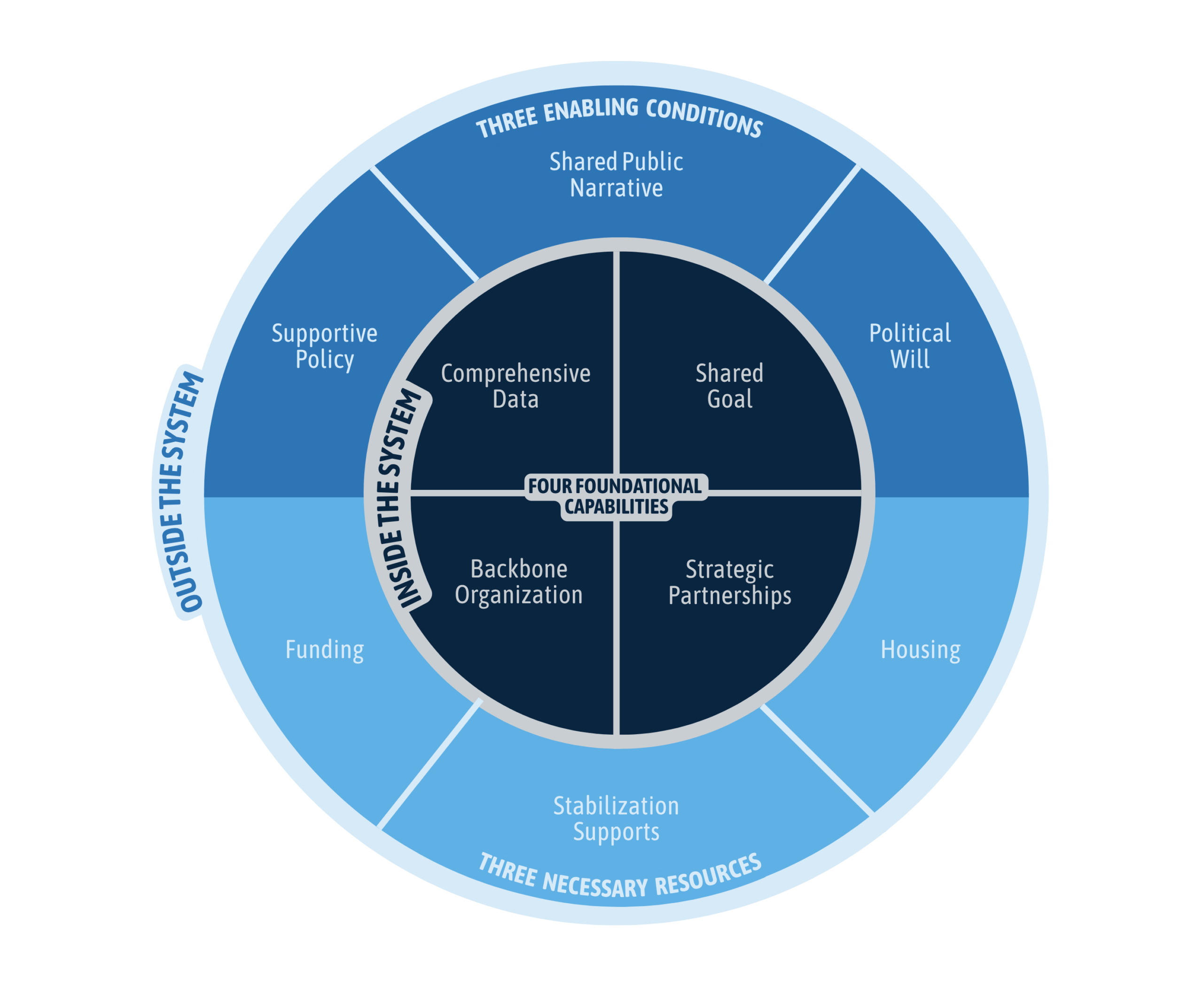
Together, these elements form a practical checklist for diagnosing barriers, aligning strategy, and sustaining results. It also simplifies the Community Level Theory of Change into a structure that’s easier to communicate, apply, and track across teams.
The Four Foundational Capabilities Every Community Needs
| # | Capability | Definition |
| 1 | Backbone Organization | A central entity (e.g., CoC, local government, community-based organization) that aligns efforts, mobilizes resources, and builds political will to achieve shared community-level goals. |
| 2 | Strategic Partnerships | Cross-sector relationships, formal and informal, bringing together housing, health, justice, philanthropy, business, elected officials, government, and people with lived expertise into a coordinated, accountable change effort. |
| 3 | Shared Goal | Community-wide, measurable targets embraced by partners, embedded in resource allocation, policy, and strategy, and communicated publicly. |
| 4 | Comprehensive Data | Real-time, person-level information system tracking inflow, outflow, actively homeless individuals, returns to homelessness, and time-to-housing. Data must be grounded in shared definitions and quality assurance practices to triage individuals effectively. |
Three Enabling Conditions That Accelerate Progress
| # | Condition | Definition |
| 1 | Supportive Policy | Local policies that remove barriers, uphold person-centered approaches, and enable coordinated, timely, data-driven responses to actual conditions. |
| 2 | Shared Public Narrative | A consistent, widely held message, reinforced by leaders, media, and institutions, framing homelessness as solvable with local accountability for results. |
| 3 | Political Will | Committed support and leadership from elected officials and policymakers to prioritize making homelessness rare and brief, and for overcoming barriers, approving policies, allocating funding, and improving cross-agency collaboration. |
Three Necessary Resources Communities Need
| # | Condition | Definition |
| 1 | Housing | A range of housing types and price points, in sufficient supply, so people have somewhere to go once they’re ready to move indoors. |
| 2 | Funding | Sufficient, diversified, flexible funding, public and private, to sustain both emergency response and long-term system infrastructure. |
| 3 | Stabilization Supports | Healthcare, treatment, employment support, and other services that help people stay housed once they’ve moved in. |
Ways of Working
To strengthen implementation efforts, communities should integrate the following practices across all elements of the framework:
Person-Specific Approach: Identify and close gaps across populations, using shared, disaggregated data to set targets, track disparities, and ensure equitable progress.
Collaborative Practice: Within the Backbone structure, co-develop community-wide strategies, share data, coordinate resources, align workflows, maintain open communication, and accountability with meaningful participation from those with lived experience.
Continuous Improvement: Adopt a learning culture. Use shared data to test ideas for reducing homelessness, scaling up successful ones, and quickly adjusting or moving on from the misfires. Ground decisions in shared data and evaluation findings, prioritizing opportunities for greatest impact on overall reductions in homelessness
Proactive Solutions: Communities that prioritize preventive, forward-looking strategies — rather than reactive measures — achieve the strongest results. They anticipate challenges by using data, engaging community members, and incorporating feedback from the people the system serves, enabling them to intervene further upstream.
Conclusion
This framework provides a flexible yet structured approach for any community to apply to organize efforts, assess progress, effectively adapt strategies, and direct collective resources for maximum impact in making homelessness rare and brief. These elements — applied locally — are found across successful communities regardless of context.
Homelessness is deeply rooted in place — shaped by unique histories, geographies, politics, and resources — and requires context-specific solutions. When communities pair these solutions with the common framework laid out here, measurable progress follows. Together, we can move from managing homelessness to measurably reducing it.